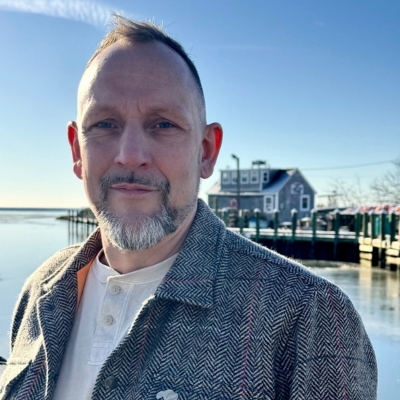
Dr. C. Patrick Heidkamp approaches geography as a central tool for shaping just and inclusive transitions. An environmental economic geographer by training, his work is grounded in critical pragmatism as a theoretical framework for examining coastal development, with particular attention to the emerging Blue Economy. Based at Southern Connecticut State University, Dr. Heidkamp is also engaged in research and teaching across the North Atlantic. He is affiliated with the High North Center for Business and Governance at Nord University (Norway) and has contributed to specialized curricula at the University Centre of the Westfjords, the University of Cologne, and Ilisimatusarfik (University of Greenland). His current work involves transdisciplinary action research in Arctic and sub-Arctic coastal regions, focusing on sustainability transitions that are community-driven and attentive to questions of equity.
Title of keynote:
“Is That the Right Thing to Do? I Just Don’t Know”:
Negotiating Blue Economy Transitions in Seyðisfjörður, East Iceland
Abstract
This lecture examines the proposed open-net salmon aquaculture project in Seyðisfjörður, East Iceland, as a window into the tensions and possibilities of contemporary blue economy transitions. The debate over this project reveals how sustainability interventions are shaped by multi-scalar frictions between national development ambitions, regional governance frameworks, and local coastal lifeworlds. Drawing on critical pragmatism and assemblage thinking, the talk explores how community members, policymakers, and industry actors negotiate uncertain futures while grappling with environmental risks, place-based identities, and competing visions of prosperity. Through ongoing transdisciplinary action research, this work highlights how justice in blue transitions emerges not from predefined policy templates but through situated, relational, and iterative processes. The case demonstrates how place, power, and temporality intersect to shape the governance of ocean development, and how community-centered transition work can reimagine what “sustainable blue futures” can look like in practice.